
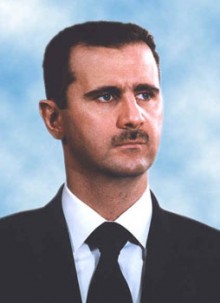
Bashar al-Assad. The last rational political leader left in the Middle East?
It’s almost exactly six months since my last post, but I’ve got a good excuse for being so dilatory. I had to whip into final shape a massive book that I’ve been working on for more years than I care to admit. But now that it’s finished and hopefully on the way to publication, it’s time to get back to the business at hand, which is charting the ongoing decline of the U.S. imperium.
What’s happened since last summer? Well, for one thing, there were the curious events in late August when the Obama administration came within a hair’s breadth of bombing Syria, backing off only when the House of Commons staged a surprise revolt against military intervention. But why should Washington have cared about a vote in faraway London? One reason is that the U.K. is a crucial ally and the U.S. could hardly afford to embark on such an adventure with the support only of France. But another is that with U.S. policy in the Middle East reaching the last stages of absurdity, it was obvious to all but a few die-hard warmongers that tossing a few hundred cruise missiles into the mix would only make matters worse. After pledging to hunt down and destroy Al Qaeda, the U.S. had found itself on the same side as Al Qaeda in the battle to overthrow Bashar al-Assad. If the effort had succeeded, the only result would have been to allow Jabhat al Nusra, the Islamic State of Iraq and Syria, and like-minded groups to overrun Damascus, slaughtering Christians and Alawites and establishing an Al Qaeda state in the heart of the Levant. It was a prospect too terrible even for the sleepwalkers in the White House, which is why Obama seized on the vote as an excuse to back down.
Reason prevailed, amazingly enough. Since then, the administration has continued driving with one foot on the brake and the other on the accelerator, opposing Al Nusra and ISIS while at the same time putting out feelers to “moderates” such as the Islamic Front whose views are hardly less genocidal. The White House still calls for Assad’s removal even though the consequences would be even more catastrophic than in South Sudan, another place where U.S. nation building has gone awry. The administration meanwhile administration supports the Maliki government in Baghdad in its battle against Al Nusra and ISIS in Anbar province, but only on the condition that it not support Assad in his battle with the same forces on the other side of the border. It is like fighting Hitler on the western front but refusing to back the Soviets fighting him in the east, an insupportable policy, in other words that can only lead to disaster the longer it goes on.
What else happened while I was laboring over my book? Oh, yes, the federal government shut down in mid-October as it teetered on the edge of default. The fact that the Republicans ultimately pulled back seems to have convinced a lot of people, including a number of Marxists, that the whole thing was for show and that, when push came to shove, there was never the slightest doubt that Congress would live up to its obligations with regard to the international capitalist system. I more or less agree even though the possibility of the Republicans doing something truly crazy can never be ruled out. Nonetheless, I think the episode is still worth taking seriously as an example of the growing stresses on the constitutional system as a whole.
Why? Leftists often dismiss the “Repocrats” as Tweedledum and Tweedledee, bourgeois parties that are two sides of the same coin as far as loyalty to the ruling class goes. This is true. But while there is no doubt that the two parties are equally loyal to the bourgeoisie as a whole, they represents different wings of the ruling class that are locked in an increasingly poisonous struggle over political and economic strategy. One wing is isolationist and authoritarian with a touch of the Old Confederacy about it, while the other is more sophisticated, “liberal,” and internationalist and hence more responsive to needs of global capital. One party seems “progressive,” while the other seems more and more the personification of Sunbelt bigotry. But what gives the debate an increasingly bitter edge is that neither strategy is really working. What with military tensions in the East China Sea, economic stagnation in Europe, and a Muslim world that is on fire from one end to the other, Obama-style internationalism is in a free fall. Yet the alternative, a retreat to some small-town Fortress America, is hardly viable either. If France and Britain were able to stage an orderly retreat in the 1950s and ’60s, it is only because they could count on an even more powerful empire to pick up the slack. But as the first – and hopefully last – global empire, America is all alone. The instant it pulls back, a power vacuum will develop and disorders will erupt. Who knows, for example, what would happen if the U.S. were declare the East China Sea a bridge too far? Would war erupt between Japan, the two Koreas, and the PRC? It is hardly farfetched, which is why the U.S. cannot afford to gamble. The empire is grotesquely over-extended, yet has no alternative but to stick with the status quo.
This makes Obama seem not only more progressive but more practical, too. But he’s not – he’s merely a deer frozen in the headlights, unable to move forward or back and therefore helpless before the coming onslaught. The U.S. should be rethinking its foreign obligations at this point and, in particular, taking steps to reduce its dependence on fossil fuels, which has the effect of inserting it ever more deeply in the affairs of an explosive Middle East. Yet for any number of reasons, it can’t. It has no choice but to stick with the current policy, disastrous as it might be.
Meanwhile, the economy remains awful for everyone but a small number of Wall Street investors while the political system grows creakier by the day. The spectacle of a small number of Republicans shutting the government down in October was indeed appalling. But when the constitutional machinery dates from the days of silk knee-britches and wooden teeth, one can expect it to seize up when under stress. The system fairly cries out for an overhaul, yet thanks to an increasingly restrictive amending clause, the prospect is unlikelier now than it ever has been in the past. Faced with all those antique pulleys and gears, Boehner & Co. couldn’t resist tossing a wooden shoe, or sabot, into the works the way striking mill workers used to in Belgium and northern France. The result was no doubt a satisfying crunching sound as the mechanism ground to a halt just as it was for the original saboteurs. Although they eventually had to pull it out, the Republicans certainly succeeded in demonstrating just how shaky and vulnerable the whole affair is.
But the GOP’s ludicrous tactics should not cause people to forget that the debt question is quite real. Contrary to all the Krugmanites out there, the federal debt burden represents a growing danger from an imperial point of view. Since the Crash of 2008, the federal debt load has risen from 68 percent of GDP to 99, nearly a fifty-percent increase. To be sure, the cost of servicing the debt has remained stable thanks to the easy-credit policies of the Federal Reserve. But you don’t have to be a Niall Ferguson to recognize just how easily the situation could change. No one knows what the precipitating factor might be, a run on the dollar, a decision by the Chinese to dump U.S. treasuries, or whatnot. But regardless of the details, the fact remains that the Fed can’t hold interest rates artificially low forever. When it finally yields to reality by allowing them to rise, the cost of servicing the debt will go up. What now seems to be a manageable debt load will suddenly grow unbearable. The consequences will make 2008 look like a passing squall.
So the U.S. is caught between equally unpalatable choices in this regard as well. It can’t not borrow because the economy would stall and it can’t borrow ad infinitum because a day of reckoning is surely on the way. The only thing it can do is stick with the present course while promising to cut back at some later date, which of course never comes. Sometimes, muddling through works; the British, after all, made it into an art form for much of the twentieth century. But in this case, it is more and more obvious that it will not do.
The brinksmanship on display in October did have one positive outcome. The disarray on Capitol Hill seems to have put to rest once and for all the ridiculous patter about the U.S. system of checks and balances being the greatest plan of government since the Garden of Eden. So complete was the breakdown that, for a few days there, the blogosphere seemed to overflow with talk about the dysfunctional government bequeathed by the Founding Fathers. “Our Broken Constitution,” Jeffrey Toobin’s entry in the field in the Dec. 9 New Yorker, was typically shallow and glib, especially since it wound by assuring readers that “the founders … left just enough room between the lines to allow for a continuing reinvention of their work.” (Translation: readers can go back to sleep.) But at least it makes clear that the perfection of the U.S. constitutional system is no longer one of those things that can be simply be taken for granted. This is a small revolution in itself.

 Daniel Lazare