Catching up…

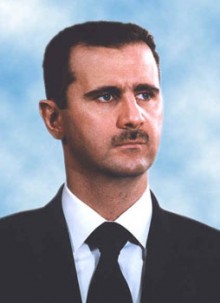
Bashar al-Assad.  The most rational political leader left in the Middle East?

Bashar al-Assad. The last rational political leader left in the Middle East?

It’s almost exactly six months since my last post, but I’ve got a good excuse for being so dilatory.  I had to whip into final shape a massive book that I’ve been working on for more years than I care to admit.  But now that it’s finished and hopefully on the way to publication, it’s time to get back to the business at hand, which is charting the ongoing decline of the U.S. imperium.

What’s happened since last summer?  Well, for one thing, there were the curious events in late August when the Obama administration came within a hair’s breadth of bombing Syria, backing off only when the House of Commons staged a surprise revolt against military intervention.  But why should Washington have cared about a vote in faraway London?  One reason is that the U.K. is a crucial ally and the U.S. could hardly afford to embark on such an adventure with the support only of France.  But another is that with U.S. policy in the Middle East reaching the last stages of absurdity, it was obvious to all but a few die-hard warmongers that tossing a few hundred cruise missiles into the mix would only make matters worse.  After pledging to hunt down and destroy Al Qaeda, the U.S. had found itself on the same side as Al Qaeda in the battle to overthrow Bashar al-Assad.  If the effort had succeeded, the only result would have been to allow Jabhat al Nusra, the Islamic State of Iraq and Syria, and like-minded groups to overrun Damascus, slaughtering Christians and Alawites and establishing an Al Qaeda state in the heart of the Levant.  It was a prospect too terrible even for the sleepwalkers in the White House, which is why Obama seized on the vote as an excuse to back down.

Reason prevailed, amazingly enough.  Since then, the administration has continued driving with one foot on the brake and the other on the accelerator, opposing Al Nusra and ISIS while at the same time putting out feelers to “moderates” such as the Islamic Front whose views are hardly less genocidal.  The White House still calls for Assad’s removal even though the consequences would be even more catastrophic than in South Sudan, another place where U.S. nation building has gone awry.  The administration meanwhile administration supports the Maliki government in Baghdad in its battle against Al Nusra and ISIS in Anbar province, but only on the condition that it not support Assad in his battle with the same forces on the other side of the border.  It is like fighting Hitler on the western front but refusing to back the Soviets fighting him in the east, an insupportable policy, in other words that can only lead to disaster the longer it goes on.

What else happened while I was laboring over my book?  Oh, yes, the federal government shut down in mid-October as it teetered on the edge of default.  The fact that the Republicans ultimately pulled back seems to have convinced a lot of people, including a number of Marxists, that the whole thing was for show and that, when push came to shove, there was never the slightest doubt that Congress would live up to its obligations with regard to the international capitalist system.  I more or less agree even though the possibility of the Republicans doing something truly crazy can never be ruled out.  Nonetheless, I think the episode is still worth taking seriously as an example of the growing stresses on the constitutional system as a whole.

Why?  Leftists often dismiss the “Repocrats” as Tweedledum and Tweedledee, bourgeois parties that are two sides of the same coin as far as loyalty to the ruling class goes.  This is true.  But while there is no doubt that the two parties are equally loyal to the bourgeoisie as a whole, they represents different wings of the ruling class that are locked in an increasingly poisonous struggle over political and economic strategy.  One wing is isolationist and authoritarian with a touch of the Old Confederacy about it, while the other is more sophisticated, “liberal,” and internationalist and hence more responsive to needs of global capital.  One party seems “progressive,” while the other seems more and more the personification of Sunbelt bigotry.  But what gives the debate an increasingly bitter edge is that neither strategy is really working.  What with military tensions in the East China Sea, economic stagnation in Europe, and a Muslim world that is on fire from one end to the other, Obama-style internationalism is in a free fall.  Yet the alternative, a retreat to some small-town Fortress America, is hardly viable either.  If France and Britain were able to stage an orderly retreat in the 1950s and ’60s, it is only because they could count on an even more powerful empire to pick up the slack.  But as the first – and hopefully last – global empire, America is all alone.  The instant it pulls back, a power vacuum will develop and disorders will erupt.  Who knows, for example, what would happen if the U.S. were declare the East China Sea a bridge too far?  Would war erupt between Japan, the two Koreas, and the PRC?  It is hardly farfetched, which is why the U.S. cannot afford to gamble.  The empire is grotesquely over-extended, yet has no alternative but to stick with the status quo.

This makes Obama seem not only more progressive but more practical, too.  But he’s not – he’s merely a deer frozen in the headlights, unable to move forward or back and therefore helpless before the coming onslaught.  The U.S. should be rethinking its foreign obligations at this point and, in particular, taking steps to reduce its dependence on fossil fuels, which has the effect of inserting it ever more deeply in the affairs of an explosive Middle East.  Yet for any number of reasons, it can’t.  It has no choice but to stick with the current policy, disastrous as it might be.

Meanwhile, the economy remains awful for everyone but a small number of Wall Street investors while the political system grows creakier by the day.  The spectacle of a small number of Republicans shutting the government down in October was indeed appalling.  But when the constitutional machinery dates from the days of silk knee-britches and wooden teeth, one can expect it to seize up when under stress.  The system fairly cries out for an overhaul, yet thanks to an increasingly restrictive amending clause, the prospect is unlikelier now than it ever has been in the past.  Faced with all those antique pulleys and gears, Boehner & Co. couldn’t resist tossing a wooden shoe, or sabot, into the works the way striking mill workers used to in Belgium and northern France.  The result was no doubt a satisfying crunching sound as the mechanism ground to a halt just as it was for the original saboteurs.  Although they eventually had to pull it out, the Republicans certainly succeeded in demonstrating just how shaky and vulnerable the whole affair is.

But the GOP’s ludicrous tactics should not cause people to forget that the debt question is quite real.  Contrary to all the Krugmanites out there, the federal debt burden represents a growing danger from an imperial point of view.  Since the Crash of 2008, the federal debt load has risen from 68 percent of GDP to 99, nearly a fifty-percent increase.  To be sure, the cost of servicing the debt has remained stable thanks to the easy-credit policies of the Federal Reserve.  But you don’t have to be a Niall Ferguson to recognize just how easily the situation could change.  No one knows what the precipitating factor might be, a run on the dollar, a decision by the Chinese to dump U.S. treasuries, or whatnot.  But regardless of the details, the fact remains that the Fed can’t hold interest rates artificially low forever.  When it finally yields to reality by allowing them to rise, the cost of servicing the debt will go up.  What now seems to be a manageable debt load will suddenly grow unbearable.  The consequences will make 2008 look like a passing squall.

So the U.S. is caught between equally unpalatable choices in this regard as well.  It can’t not borrow because the economy would stall and it can’t borrow ad infinitum because a day of reckoning is surely on the way.  The only thing it can do is stick with the present course while promising to cut back at some later date, which of course never comes.  Sometimes, muddling through works; the British, after all, made it into an art form for much of the twentieth century.  But in this case, it is more and more obvious that it will not do.

The brinksmanship on display in October did have one positive outcome.  The disarray on Capitol Hill seems to have put to rest once and for all the ridiculous patter about the U.S. system of checks and balances being the greatest plan of government since the Garden of Eden.  So complete was the breakdown that, for a few days there, the blogosphere seemed to overflow with talk about the dysfunctional government bequeathed by the Founding Fathers.  “Our Broken Constitution,” Jeffrey Toobin’s entry in the field in the Dec. 9 New Yorker, was typically shallow and glib, especially since it wound by assuring readers that “the founders … left just enough room between the lines to allow for a continuing reinvention of their work.”  (Translation: readers can go back to sleep.)  But at least it makes clear that the perfection of the U.S. constitutional system is no longer one of those things that can be simply be taken for granted.  This is a small revolution in itself.

Political paralysis and the drift to war

LSD manufacturer Owsley Stanley at his arraignment in 1967.  Where is he now that we really need him?

LSD manufacturer Owsley Stanley at his arraignment in 1967. Where is he now that we really need him?

In case you haven’t noticed, the Middle East is exploding.  Yes, I know, it’s always exploding, but this time is different.  In a replay of the fitnas that raged across the Muslim world in the seventh and eighth century, the Shiite-Sunni conflict is flaring from the Persian Gulf to the Nile, threatening to bring the entire region down with it.  Is an extremely ugly situation with no obvious way out.  So what should the United States do in response?  The only answer is to get itself out of harm’s way double quick.  Nothing it does will make the situation better and, in fact, will only make it worse.  So the only solution is to pull out before it finds itself badly singed as well.

But it is impossible to withdraw from the Middle East without addressing what got the U.S. involved in the first place, i.e. oil.  With per-capita consumption double or triple West European levels, America is far and away the heaviest major user of fossil fuels in the world.  Despite the recent uptick in domestic energy production, it remains massively invested in the Middle East, not only as a consumer but as the leader of a global economy that is highly dependent on fossil fuels as well.  The situation is grim, therefore, but not hopeless.  If only on a technical level, the solution is actually rather easy.  All the U.S. has to do to dig itself out of its hole is (a) institute a comprehensive program of carbon taxes and other reforms aimed at de-incentivizing fuel consumption and encouraging a shift to conservation and alternate energy sources and (b) re-jigger the tax code so as to preserve progressivity and insure that the burden does not fall on workers and the poor.  As any competent economist will attest, human beings are highly price sensitive.  Keeping prices artificially low creates the illusion that oil is cheap and abundant, no matter how much you tell them otherwise.  Taxing oil and eliminating a host of hidden subsidies such as free highways and free parking drives home the point that fossil fuels are actually highly expensive once the full range of associated costs – global warming, military expenditures, etc. – are factored into the equation.  Directing the resulting revenue stream to other forms of transport renders everything from trains and trolleys to walking and cycling more attractive and more competitive.  Americans may claim to love their SUVs, but all you have to do is change the price structure to see how fast tastes can alter.

So in the end it is rather simple.  All Barack Obama, Harry Reid, and John Boehner have to do is lay the problem out, come up with a plan that is both simple and effective, and then walk it through Congress.  No U.S. politician likes voting for a new tax no matter how many good causes it will fund.  But no U.S. politician wants to be ensnared in a nightmare like the one unfolding in the Middle East.  So once the situation has been explained, we can be confident that the people’s representatives in Washington will do the right thing by putting the country on the path to energy sanity.

Thank God for LSD, eh?  So much better than the dreary reality we all find ourselves in….

In fact, the chances of anything like this happening are absolute zero.  If Obama were to so much as whisper the phrase “carbon tax,” the Republicans would begin firing on Fort Sumter while the Democrats would head for the hills.  Not only does America’s superannuated political system render any such reform impossible, it makes it impossible even to think about it in a rational, comprehensive way, which is why no pundit who wants to be seen as practical and realistic would so much as pen an op-ed article on the subject.  Global warming is accelerating while conditions in the Middle East grow more dangerous by the day.  Yet both the White House and Congress are structurally incapable of doing anything other than burying their collective head in the sand.

This is an old story, admittedly.  But think what the consequences of such political paralysis will be.  While carbon taxes would lead to higher prices at the pump, the effect on the global oil market would actually be the opposite.  By putting the world’s most voracious oil consumer on a diet and inviting others to follow suit, it would send a message to producers like Saudi Arabia that the market for their sole export is shrinking.  The pressure on prices would be increasingly downward.  Not acting, on the other hand, sends a message that demand will continue despite the depressed capitalist economy.  Prices will remain strong, while profit margins will stay healthy.  Thousands of Saudi princes will rest secure in the knowledge that they can to continue blowing huge wads of cash on casinos, prostitutes, and Ferraris while arms will continue flowing to Wahhabist pro-Al Qaeda rebels in Syria.  Considering that Saudi Arabia already spends an astounding 13 percent of GDP on its military – nearly fifty percent more than what Israel spends – U.S. arms manufacturers will also have the satisfaction of knowing that generations of petro-sheiks will continue buying F-16s and other baubles.  But it will also means deeper involvement on the part of the Pentagon and a growing likelihood of American “boots on the ground” in Syria and elsewhere.

Mobil, Exxon, and Grumman will make out very well.  But more and more sons and daughters of the American working class will come home either in body bags or minus various organs and limbs, while the consequences for the masses of ordinary people in the Middle East will be even more horrendous.  In a 2009 cable made public by Wikileaks, Hillary Clinton confided to her fellow diplomats that “donors in Saudi Arabia constitute the most significant source of funding to Sunni terrorist groups worldwide.”  If so, then with crude currently at $105 a barrel and rising, higher in real terms than even during the oil spikes of the 1970s and early ’80s, U.S. energy policies enable them to donate even more.  The effect is to fuel terrorism even as Washington launches massive domestic-monitoring operations to supposedly combat it.  It’s the best of all possible worlds for militarists and authoritarians.

The deepening constitutional rot in Washington is thus not only a domestic problem but an international one as well.  Looking back across the decades, we’re often struck by how clever the architects of the post-war capitalist order were.  Instead of the renewed depression that everyone expected (the threadbare Oceania of Orwell’s 1984 is a perfect example of this mindset), they engineered a 25-year boom that remade the world.  They stumbled badly in Vietnam, but recovered sufficiently under Reagan and Bush I to vanquish the Soviets and impose law and order of a sort in the Persian Gulf.  But as the economy has crumbled, the instability has deepened.  Although Americans still think of him as a liberal do-gooder, Obama has done nothing to stop the drift to war.  In fact, with his ready resort to drone warfare, his subservience to the Saudis, Qataris, and Turks, and his sword-rattling in Syria, he’s done everything to exacerbate it.  The masses are sleepwalking over a precipice, yet so far there seems to be no way to wake them up.

I think I need another hit of that acid….

Principled thoughtlessness

Jonathan Schell ... liberal constitutionalist

Jonathan Schell … liberal constitutionalist

Jonathan Schell has the lead editorial in The Nation this week on – what else? – the Edward Snowden affair.  The piece is a classic of liberal constitutional analysis, and not in a good way.  How did it happen, Schell wants to know, that the federal government came to launch a massive internet dragnet aimed at downloading information from countless emails and phone calls?  The answer, he says, is by straying from the true path laid down by the founders two-plus centuries ago: “If there is any single political idea that deserves to be called quintessentially American, it is the principle that government power must be balanced and checked by other government power, which is why federal power is balanced by state power and is itself divided into three branches.”  Yet as surveillance mania intensified after 9/11, checks and balances were nowhere to be found.  Casting aside their “appointed constitutional role[s],” the three branches plunged in headfirst.  Instead of objecting when the Bush administration adopted “warrantless domestic surveillance by the NSA,” Congress incorporated some of the program’s worst features into federal law.  The courts failed to protest, with the result, Schell now writes, that “[o]ur system of checks and balances has gone into reverse …. Balanced, checked power has become fused power – exactly what the founders of this country feared above all else.”

If this is what gave the founders shivers back in the 18th century, then it is our patriotic duty to be doubly terrified today.  Schell’s solution is to undo “this executive usurpation” by returning checks and balances to all their ancient glory:

What’s needed is counterrevolution – an American restoration, returning to and reaffirming the principles on which the Republic was founded.  Edward Snowden … saw that when government as a whole goes rogue, the only force with a chance of bringing it back into line is the public.  He has helped make this possible by letting the public know the abuses that are being carried out in its name. …  He based his actions on the finest traditions of this country, which its current leaders have abandoned but which, he hopes, the current generation of Americans still share.

Instead of going forward, it is necessary to go back to the past.  Presumably, 99 percent of American liberals agree with Schell on this count, as would many Tea Partiers, even if they did not quite share in his enthusiasm for Snowden.  But this just shows how pervasive this sort of retrograde thinking has become.  Liberals and conservatives are of one mind that the founders represented an unsurpassable summit of political wisdom and that it is the fate of us moderns to forever labor in their shadow.  Instead of thinking for ourselves, we must conform to their dictates.  If the founders believed in checks and balances, then we should, too.  If they feared a fusion of powers above all else, then out knees should positively shake at the prospect.  Like Little Red Riding Hood, we must nevert deviate from the path laid down by a long-ago group of slaveholders, merchants, and lawyers.

It is child’s play to pick this strain of argument apart.  Take, for example, Schell’s casual reference to certain ideas as “quintessentially American.”  The phrase is certainly apt when it comes to checks and balances and the like.  But does that make them any better than, say, ideas that are quintessentially French or British?  As all-American as checks and balances are, how do we know they are true?  Because James Madison said so?  Schell’s notion that the public is “the only force with a chance of bringing [government] back into line” makes little sense.  The word “public” is troublesome because it is supra-political.  (The public interest is always said to trump narrow partisan interest.)  But leaving that aside, why would a unified public take charge of America’s out-of-control government only to see its authority sundered into three separate parts?  If “we the people” are the source of all political power in the United States, then it seems that their “appointed constitutional role” is to subdivide their own authority and turn it against itself.  Since a house divided against itself cannot stand, why do it at all?  Why not strive for true popular sovereignty in which the people reign over the whole of society as a single undifferentiated force?

As I showed in The Frozen Republic, constitutional traditionalism of the sort that Schell represents goes back at least to the Elizabethan Age when English government was also divided along legislative, executive, and judicial lines.  (The union of functions under an all-powerful House of Commons would not get underway until the 18th century.)  Since then, whenever anything has gone wrong, a certain kind of old-fashioned patriot could be counted o[n to cry out that it’s all because those in power have failed to stick to the good old old ways while the various branches have failed to maintain eternal vigilance in defense of ancient liberties.  The solution, invariably, is to restore the “ancient constitution,” as it was known, with all its checks and balances and separation of powers.  It’s a formula that has been applied to everything from the Stamp Act to electronic snooping.  Yet because it is repetitive, boring, and patently ahistorical, people nod their heads in agreement but otherwise pay less and less attention — which probably suits people like Schell fine since it confirms them in their view that the modern world is going to rack and ruin.

One effect of such thinking is to ignore the specifically new things that have contributed to the current crisis.  Rather than separation of powers (or lack thereof), the real problem is a vast acceleration of militarism and imperialism since 9/11 and a corresponding shrinkage of political democracy.  Political debate virtually shut down the moment the first airliner crashed into the World Trade Center.  Journalists who failed to toe the official patriotic line – they hate us because they hate our freedom – were fired, questioning of any sort was essentially prohibited, and the draconian Authorization for Use of Military Force (AUMF) sailed through Congress with only a single dissenting vote (that of Representative Barbara Lee, who was so frightened by the reaction that she refused to talk about it for six months after).  Since then, it has been impossible to criticize the war on terror in any fundamental way and hence impossible to criticize in any fundamental way the repressive apparatus that goes along with it.  The war machine is on automatic pilot as a consequence, with no oversight by Congress, the courts, or even Obama, who by this point seems to be little more than a tool of the NSA and CIA.  The war on terror was supposed to wipe Al Qaeda off the face of the earth, along with its assorted aiders, abettors, and apologists.  Yet no one seems to notice that the U.S. now finds itself effectively allied with Al Qaeda in the struggle to overthrow the Assad regime in Syria.  It is manufacturing the terrorism it has pledged to combat.  One would think that the Congress and the media would be up in arms over this obvious violation of the Bush doctrine that if you aid a terrorist, you’re no better than a terrorist yourself.  Yet there is only silence as the U.S. blunders into yet another Mideast war in Syria.  Americans are so deferential to the past that they have quite forgotten how to think for themselves in the present.

Sovereignty and the Constitution

Jefferson: The Great Satan of American history?

Jefferson: The Great Satan of American history?

Tocqueville may not have been very likable, but his theory about the Puritans planting the seeds of democracy was not incorrect.  One could take issue with certain details.  Despite his theory about democracy gently unfolding in the New World, the Revolutionary War turns out to have been a good deal more violent, more intolerant, more French in a sense, than he realized.  An entire political party, the Tories, was banned and, as the historian R.R. Palmer  pointed out in his magisterial  study, The Age of the Democratic Revolution, five times as many people were sent into exile as in France relative to the population while at least as much émigré property  was confiscated.  Moreover, if Tocqueville hadn’t died of tuberculosis in 1859, he would have realized that 1776 was actually a warm-up, comparable to the moderate, Girondin phase of the French Revolution, while the Civil War marked the start of a second and more extreme stage comparable to the Jacobin takeover in June 1793.  True, no guillotines appeared on Capitol Hill in 1861-65.  But the war would claim the life of one American in forty and would lead to the wholesale expropriation of the Southern plantocracy.  It would see a forced march toward political and economic centralization, industrialism, nationalism, and mass education (Congress established the land-grant college system in 1862), all causes as dear to the Jacobin heart as they now were to the radical Republicans  The war would even see something of a Jacobin-style political dictatorship.  Habeas corpus was suspended as a rump Congress from which Southern Democrats had been expelled prosecuted the war in an increasingly radical manner.  American development was more revolutionary and less exceptional than Tocqueville or his modern admirers understood.

So Tocqueville clearly got a good deal wrong.  But he got one thing right concerning the nostalgic quality of American politics.  Because the American colonies had been self-governing, most classically in Puritan New England, overthrowing the ancien régime was the last thing the revolutionaries of 1775-76 wanted to do.  To the contrary, it was the British who wanted to overthrow it, while the so-called revolutionaries wanted nothing more than to put it back on the throne.  Once Jefferson had ladled out a dollop of fashionable rationalist rhetoric about life, liberty, and the pursuit of happiness in the Declaration of Independence, he  devoted the bulk of the document to all the terrible new things the British had done – interfering with traditional colonial legislatures, usurping ancient liberties, and “taking away our charters, abolishing our most valuable laws, and altering fundamentally the forms of our governments.”  Britain stood for change while the patriots stood for the status quo.  A 91-year-old veteran of the Battle of Concord summed things up in a remarkable interview he gave in 1842.  “Did you take up arms against intolerable oppressions?” Captain Preston was asked.

     “Oppressions?  I didn’t feel them.”

     “What, were not oppressed by the Stamp Act?”

     “I never saw one of those stamps.  I certainly never paid a penny for one of them.”

     “Well, what then about the tea tax?”

     “I never drank a drop of the stuff; the boys threw it all overboard.”

      “Then I suppose you had been reading Harrington or Sidney and Locke about the eternal principles of liberty?”

     “Never heard of ’em.  We read only the Bible, the Catechism, Watts’ Psalms and Hymns, and the Almanac.”

     “Well, then, what was the matter?  And what did you mean in going to the fight?”

     “Young man, what we meant in going for those redcoats was this: we always had governed ourselves, and we always meant to.  They didn’t mean we should.”

One can almost hear Tocqueville chortling in his grave.  As Palmer pointed out, revolutionary conservatism of this sort was not unique in the late eighteenth century.  In the years leading up to 1789, liberal aristocrats in France demanded a return to the balanced constitution of yesteryear when regional parlements controlled by the nobility served as a check on royal authority.   In Switzerland, alpine traditionalists demanded a return to cantonal gatherings in which freemen would signal assent by pounding the floor with their spears and halberds.  Such elements would soon be overwhelmed by urban radicals calling for specifically new forms of government, but for a variety of reasons the local gentry in America would remain in the ascendant for decades after.  Even though the Virginia planters had disgraced themselves during the War of Independence — they had been too worried by slave uprisings to offer resistance to the British — they were still dominant when the “framers” gathered in Philadelphia n 1787 to draft a new constitution.  Hence, the aristocratic ideal of constitutional balance proved dominant.  Virginians like James Madison wanted a strong central government to keep the states from flying off into the arms of Britain, France, and even Spain.  But they did not want one that was so strong that it would threaten local prerogatives.  They wanted a government that was centralist but not too centralist, vigorous but not excessively so, forward-looking but at the same time protective of ancient liberties, first and foremost of which was the liberty to own slaves.

Years of war and turmoil had upset the old equilibrium, but now the Virginians were determined to put it back.  Since it was impossible to simply turn back the clock, the government would have to be new.  But it would be a new government dedicated to the restoration of ancient values going back to Plymouth Rock and Tudor England.  Instead of straightforwardly embracing progress, the planters, lawyers, and merchants who gathered in Philadelphia would execute a complicated maneuver in which they stepped boldly into the future in order to retreat into the past.

Structurally, the document that emerged from the convention adhered to the pattern set by the Declaration of Independence: lofty rationalist rhetoric followed by more down-to-earth sentiments.  Where the declaration began with the view “that whenever any form of government becomes destructive … it is the right of the people to alter or to abolish it,” the Constitution opened with a similar blast announcing that “we the people” were organizing a new government in order to enhance what the declaration identified as “safety and happiness” — which is what phrases like “form a more perfect union, establish justice,” etc., essentially meant.  Just as the first document failed to address the issue of the lawfulness of American independence, the Constitution skirted the issue as well by failing to acknowledge that Article VII, which declared that the new plan of government would become law when approved by just nine states, was in direct violation of the Articles of Confederation, still the law of the land, which required that any constitutional alteration be approved by all thirteen.

Then the new constitution got down to the nitty-gritty by setting forth the powers of Congress, the president, the courts, and so forth.  The new government would have the power to coin money, establish weights and measures, and punish counterfeiters, but not to interfere with the slave trade for at least twenty years.  Once that was out of the way, the document turned to the question of how it was to be amended.  Moments after establishing the people as the omnipotent makers and breakers of constitutions, it announced that they would henceforth be subject to the severest of constraints.  Changing so much as a comma in the Constitution would require the approval of two-thirds of each house of Congress plus three-fourths of the states.  At the time, Article V meant that just four of the 13 states representing as little as 9.7 percent of the total population would be able to veto any change sought by remainder.  Today, it means that thirteen out of the 50 states can do the same even though their share of the population stands at as little as 4.2 percent.  (In a couple of decades, it will be down to just 3.9 percent.)  Over the course of a few thousand words, the people had gone from being all-powerful to virtually powerless.

A gaping contradiction of this sort should have been a weakness, but, paradoxically, turned into a strength.  Since the new constitution was the only thing holding the country together, everyone pitched in to impose sense on the senseless.  The brightest minds in the land joined in the effort.  Furious debates erupted over whether the federal government’s powers were limited, as the list of delineated powers in Article I seemed to suggest, or unlimited as the necessary-and-proper clause (“The Congress shall have power … to make all laws which shall be necessary and proper for carrying into execution the foregoing powers and all other powers vested by this Constitution in the government”) clearly implied.  They argued over whether the Second Amendment permits gun control, over the proper boundary between state and federal powers, and over the question of whether the document was to serve as a “living Constitution” i.e. one subject to continuous re-interpretation, or whether the “original intent” of the founders would be determinative.

Since the Constitution had given rise to the greatest nation that had ever existed, it simply had to make sense, which meant that such questions had to have a definite answer pro or con.  But it ain’t necessarily so.  A constitution that describes the people as simultaneously sovereign and non-sovereign is incoherent, which means that meaning is not necessarily to be found.  The document thus condemned Americans to argue endlessly over issues that were essentialy unresolvable.  Indeterminacy became an instrument of control.

Constitutional incoherence condemned politics to incoherence as well.  By the nineteenth century, Americans  had a great deal to argue about — slavery, urbanization, centralism versus local control, and so on.  But instead of debating such matters, they argued mainly about themselves — whether they had the authority to do what they wanted to do, whether they dared exercise their powers in full, etc.  It is important to keep in mind that the people did not assert their sovereignty in Philadelphia in 1787.  Rather, the founders invoked it.  Once they uttering the magic incantation, moreover, they hastened to put the genie back in the bottle by declaring the people all but powerless to alter their own plan of government.  Popular sovereignty thus became a one-off affair, a spirit that briefly hovered over the new nation and then went away.

The upshot was a form of self-nullification.  The instant the people  turned on their power, they hastened to switch it off, condemning themselves to a permanent state of schizophrenia in the process.  Americans wanted a government that would cater to their needs but feared that it would threaten liberty if it did.  They wanted strong communities but not the political mechanisms needed to make them so.  They wanted vigorous democracy but were deeply ambivalent as to what democracy might actually mean.  They want progress but also a return to traditional values.  They thus demonstrate their own powerlessness and incoherence at every turn.  They wanted sovereignty except that they didn’t.

Democratic politics are crippled as a consequence.  The American political system is arguably the worst in the advanced industrial world, i.e. the most corrupt, the most unresponsive, the most punitive and authoritarian.  Income polarization is accelerating, the super-rich are increasingly bold in pursuing their own interests, while. economically, millions of working people continue to deteriorate.  Yet they are seemingly condemned to stand idly by as their society plunges downhill.  The theoreticians tell us that the one thing a sovereign cannot do is put an end to his own sovereignty, but putting an end to the people’s sovereignty is just what the Constitution has succeeded in doing for more than two centuries.  This is logically impossible, yet it is a fait accompli.  The question is how much longer this absurd state of affairs can continue.

Tocqueville

Alexis de Tocqueville by Théodore Chassériau

Alexis de Tocqueville by Théodore Chassériau

Liberals are like the man who kills his parents and then pleads for mercy on the grounds that he’s an orphan.  The ideology arose out of the fierce struggles against the ancien régime in the 17th and 18th century.  Yet once it reached maturity in the mid-nineteenth century, it dedicated itself to forgetting  that had ever been the case.  In England, the Victorians tried to cover up a century of political turbulence that began with the outbreak of civil war between Parliament and the crown in 1642 and did not end until 1745 when “Bonnie Prince Charlie,” leader of an army dedicated to restoring the old Stuart dynasty, advanced to within 200 miles of London before being defeated in the Battle of Culloden.  A hundred years later, the Victorians had decided that civil war was inimical to the British character and that radicalism was for other people, most notably the ever-excitable French.  Across the channel, collective amnesia was not so easily gained since memories of La Terreur were still so fresh.  Liberals agonized, consequently, over how to achieve stability with royalists and republicans still going at one another in the streets.  How could France detach itself from its revolutionary past when the old battles were continually erupting anew?

The ultimate self-made orphan was Alexis de Tocqueville, whose Democracy in America, published in 1835-40, is still the book that American exceptionalists most love to quote.  As the noble particle suggests, Tocqueville was born into an aristocratic Norman family going back to the days of William the Conqueror.  His father narrowly escaped the guillotine in 1794, his hair supposedly turning snow white from the ordeal, but other relatives were not so lucky.  The experience could have turned Tocqueville into a royalist, but instead he made  peace with the new regime, swearing allegiance to the liberal “bourgeois king” Louis-Philippe after he took the throne in 1830.  Democracy, he believed, was unavoidable in the new age.  But he wanted democracy shorn of the revolutionary sturm und drang that had ushered it in.  Hence his fascination with the United States, a new republic that had seemingly entered into the new age effortlessly and painlessly.

“The circumstances that accompanied their birth,” he said of the modern nation-state, “…affected the whole term of their being.”  Tocqueville was especially taken with the New England Puritans as the people who planted the seeds of democracy in the New World.  Unlike the paupers and adventurers who flocked to Virginia, they were members of the educated middle class.  Immediately upon landing at Plymouth Rock, the Pilgrims (actually a branch of the larger Puritan family) promised to “combine ourselves together into a civil body politick, for our better ordering and preservation, and … enact, constitute, and frame such just and equal laws, ordinances, acts, constitutions, and offices, from time to time, as shall be thought most meet and convenient for the general good of the Colony: unto which we promise all due submission and obedience.”  This was popular sovereignty avant la lettre, and yet it all just fell into place without the assistance of the guillotine.  By 1650, the Puritans were instituting compulsory education and fining parents who failed to comply, levying taxes, appointing clerks to record births, marriages, and deaths, surveying property, and supporting the poor, all at a time when royal absolutism in Europe was crushing local liberties underfoot.

American democracy was born rather than made, which is why Tocqueville found it so fascinating.  Instead of revolting against the past, Americans continually sought to return to that halcyon period in the 17th and 18th century when popular self-government was at its purest.  Tocqueville longed for something similar in France, yet revolution and democracy at home were two sides of the same coin.  During the Revolution of 1848, he argued for an American-style constitution with a bicameral legislature and an elected presidency, but got nowhere.  Then, as the revolution heated up, he supported General Cavaignac’s crackdown on the Parisian workers, backed restrictions on civil liberties, and in June 1849 pleaded with the interior minister, Jules Dufaure, to impose a state of siege and prohibit demonstrations.  After calling for a Bourbon restoration against Louis Napoleon’s in 1851, he was forced into retirement.

Tocqueville thus turned against the revolution that had made democracy in the first place and then pleaded for sympathy against Napoleon III’s coup d’état.  Not much to be proud of here.  Post-1945, however, the United States has imposed a generally Tocquevillian agenda, not only in France but throughout the world, based on a concept of conservative democracy in which popular sovereignty is all but eliminated via entrenched constitutional guarantees, international agreements, and so forth.  The aim was to rule out revolution as unnecessary and even un-democratic unless directed against the tottering post-Stalinist regimes of Eastern Europe, in which case it became de rigueur.  Personally, I’ve always thought that Democracy in America was overrated and that Frances Trollope’s Domestic Manners of the Americans was not only better written and more informative, but much more fun.  But Trollope doesn’t fit the American political agenda the way Tocqueville does and so remains less well known.

On sovereignty

imagesContrary to popular opinion, sovereignty does not mean power but absolute power – “supreme, irresistible, absolute, uncontrollable authority,” as the eighteenth-century legal scholar William Blackstone put it.  Since Bodin and Hobbes, a certain school of political theorists have argued that truces or agreements were insufficient to keep civil war from erupting within society and that what was needed was a power over society sufficient overwhelming to constrain any and all elements within.  Whether the sovereign was the king, the aristocracy, or the general population was secondary; the only thing that mattered was that he be in a position to brook no argument.  Since his authority was “irresistible,” his word would be law and no rebel or faction would even think of challenging it.

But Blackstone’s definition raises as many issues as it resolves.  The most obvious is that of liberty.  “Uncontrollable” means that it is the sovereign’s function to control others rather than being controlled in return.  But how is uncontrollable power even remotely compatible with freedom?  Doesn’t liberty mean limits on governmental authority, i.e. a point where state power leaves off and individual autonomy begins?  Regardless of whose hands it is in, how can total power be anything other than crushing?

Another issue concerns that of extent.  Supreme, irresistible, and absolute, yes – but over what?  Rather than a society of feudal orders, sovereignty presupposes a territorial state in which the supreme diktat is uniformly applied.  But a system of territorial states means that a French sovereign’s territory will abut that of a German or Swiss sovereign, and since each regards his power as irresistible, neither will be in a position to defer to the other.  Indeed, the theory of sovereignty requires that they not defer since doing so would mean admitting that one’s own power is less than absolute.  If sovereignty eliminates the problem of civil strife within society, it does so at the cost of stepped-up warfare between and among the territorial states.  It kicks the problem upstairs, which arguably leads to something even worse.

Finally, there is the issue of supremacy.  Blackstone conceived of the problem in legal terms.  The sovereign was the supreme legislator, executive, and judge.  His will trumped whatever laws a lesser body, such as a municipal council or a provincial parliament, might approve.  But why just the law?  If the sovereign is truly supreme over society, shouldn’t he be supreme with regard to the social and economic spheres as well?  How about nature – shouldn’t he be supreme over that?  Does the process have an end-point or what?

The answer is that it does not and should not have an end-point and that all progress depends on it continuing indefinitely.  The more complete the monopoly, the better society will be.

If this sounds strange or nonsensical, it is important to keep in mind that the transition from royal to popular sovereignty did not involve just a transition from one locus to another, but a transform that, in a sense, turned the phenomenon inside out.  A king claiming absolute authority necessarily deprives his subjects of power.  But a people claiming absolute power do not.  To the contrary, they mobilize their resources collectively and hence individually as well.  They become the sole legislator, executive, and judge, not over others but over themselves.

The Preamble to the U.S. Constitution captures the self-reflexive nature of the process quite nicely:

We the people of the United States, in order to form a more perfect union, establish justice, insure domestic tranquility, provide for the common defense, promote the general welfare, and secure the blessings of liberty to ourselves and our posterity, do ordain and establish this constitution for the United States of America.

The key words are the first seven and final twelve: “We the people of the United States … do ordain and establish this constitution for the United States of America.”  The people act on themselves, taking their own society in hand and restructuring it for their own benefit.  While the verbiage in between may seem rather vague and open-ended, phrases like “promote the general welfare” simply establish the goal of making society better, which is to say more peaceful, orderly, productive, secure, and just.  Put together, the whole thing adds up to a vow on the part of the people to use their “supreme, irresistible, absolute, uncontrollable authority” to remake society in their own image.  Sovereignty is thus self-serving.  It’s sole raison d’être is to strengthen its own.  But since this means strengthening democratic society, it is a case of the people using their own power to benefit themselves.

But what about liberty?  Requiring the people to promote the general welfare means requiring them to do what the Preamble wants them to do, not what they might wish to do instead.  True enough.  But since the people are the authors of the preamble, requiring them to abide by the Preamble means committing themselves to a goal that they themselves have set.  Someone who goes in a diet is not less free by virtue of having to bypass the refrigerator.  To the contrary, he is more free because, by asserting unlimited power over himself, he is taking full control of his own activities.  While royal sovereignty might require everyone else to march in lockstep, popular sovereignty requires something quite different.  Since the people have resolved to secure the blessings of liberty for themselves and their posterity, it requires them to collectively determine what those blessings are and how to attain them.  In a sense, this means marching in lockstep toward democracy.  But since democracy rests on collective mentation, it also requires as much of the population as possible engaging in full-throated debate.

The people command themselves to be democratic.  But since the one thing a sovereign cannot do is terminate his own sovereignty, a sovereign people has no need to open the door to racism, fascism, or other anti-democratic points of view.  Rather than free speech, popular sovereignty means democratic speech, which is to say speech structured in such a way as to strengthen democracy.  Where to draw the line between democratic and anti-democratic speech is up to the people themselves.  Where they might draw the sharpest possible distinction in an emergency, under normal circumstances they might decide to relax and loosen up.  But in keeping with the principle of self-reflexivity, their sole concern either way is to advance their own interests and thus reinforce their own rule.

As for the issue of extent, popular sovereignty does not eliminate the problem of the sovereign territorial state, but, to the contrary, raises the issue to a whole new level.  Territoriality has led not only the growth of international war but of international law as well.  But international law is a paradox.   Not only does it do nothing to rein in international conflict, but, by regulating it, it arguably serves to legalize it and thus validate and encourage it.  By erecting a welter of treaties and international agreements, moreover, it serves to bottle up popular sovereignty within each state.  The process has reached a reductio ad absurdum with the European Union, a super-state ostensibly based on neo-medieval theories of “subsidiarity” in which sovereignty gives way to a whole gradation of lesser and greater authorities, everything from national governments in places like Paris and Rome to the notorious bureaucrats of Brussels, the European Central Bank in Frankfurt, the European Parliament in Strasbourg, and so on.  It is as if Bodin and Hobbes had never existed.  Although the ostensible goal is to promote freedom and prevent war, the result has been to fragment and break up democracy and so clear the way for an untrammeled “liberal” (in the classic 19th-century sense) economic order.  While limiting the illimitable has led to political stability for a time, the consequence is now likely to be the opposite as Europeans struggle to cope with a deepening economic collapse.

The solution, therefore, is not more agreements between sovereign states (which henceforth cease to be sovereign), but the internationalization of popular sovereignty and hence its fulfillment.  If the creation of a democratic authority that is unconstrained by international boundaries or international law has been the dream of revolutionaries from Anarcharsis Cloots to Karl Marx and beyond, it is not because intellectuals are always letting their imagination get the better of them, but because it remains the only conceivable solution to the problem of international conflict.

This is radical stuff, which is why everything about the EU is designed to prevent it.  Meanwhile, it is with the supremacy issue that popular sovereignty is most transformative.  Self-reflexivity, the principle that sovereignty exists solely to augment its own power, means that it is programmed for permanent growth and self-development.  The early theorists had little idea of what this would mean.  Bodin, who wrote his Six Books of the Commonwealth in 1576, assumed that private property was sacrosanct and that the sovereign should nurture religious piety for the sake of morality and the common good.  Seventy-odd years later, Hobbes understood that there could be no absolute right to private property, but still held to a rather blinkered of the sovereign state as existing merely “to preserve the people in peace at home and defend them against foreign invasion” (chapter 25).  The Jacobins were far more radical: in the name of popular sovereignty, they imposed rationing, set wages and prices, punished profiteers, confiscated émigré property, and abolished feudal tithes and fees.  But it was not until the industrial revelation that people really got a glimpse of the forces society was capable of unleashing.  In what must have been shock to the German émigrés who commissioned it, the Communist Manifesto thus opened with a paean to the virtues of capitalist creativity, which “has accomplished wonders far surpassing Egyptian pyramids, Roman aqueducts, and Gothic cathedrals; it has conducted expeditions that put in the shade all former exoduses of nations and crusades.”  The purpose of socialism was not to put the industrial genie back in the bottle, but to give it more scope.

The upshot was popular sovereignty raised to the nth degree and, interestingly enough, self-reflexivity raised to the nth degree as well.  In his famous blast against religion as the opium of the people, the young Marx also observed: “The criticism of religion disillusions man to make him think and act and shape his reality like a man who has been disillusioned and has come to reason, so that he will revolve around himself and therefore around his true sun.  Religion is only the illusory sun which revolves round man as long as he does not revolve round himself.”  Rather than subordinating man to nature, Engels wrote in 1876 that the goal was to dominate nature so completely so that the distinction between man and nature would be all but eliminated.  The more science advances, he wrote, “the more will men once more not only feel, but also know, themselves to be one with nature.”  Man, in a sense, would become the Spinozan deity who has so thoroughly mastered nature’s laws that he virtually runs it the same way an engineer runs a locomotive.

To translate this into the language of sovereignty, it means that human sovereignty will have become so total that the distinction between subject and object will have been lost.  Man will act on himself so completely and continuously that he will no longer be conscious even of the process.  This is widely dismissed as utopian when in fact it is the alternative belief that humankind will remain paralyzed in the face of a growing list of problems, everything from the economic crisis to global warming, that is utopian.

Constitutional rigidity

805UNLOCK“We might as well require a man to wear still the coat which fitted him when a boy as civilized society to remain ever under the regimen of their barbarous ancestors.”  This was Thomas Jefferson’s famous blast at constitutional rigidity, set forth in a letter in 1816 to a Virginia lawyer named Samuel Kercheval.  Jefferson was one of the slipperiest men ever to occupy the White House, and his words often mean the opposite of what they might initially seem.  Nonetheless, what he seems to be saying here is that government, not only the individual office-holder but the actual structure, must change with the times.  This certainly makes sense.  But what if the coat that the grown man puts on is not only the same one he wore as a boy, but one that is half the size and getting smaller by the year?

This is the nub of the problem facing the U.S. constitutional system.  The amending clause in Article V states:

The Congress, whenever two thirds of both Houses shall deem it necessary, shall propose Amendments to this Constitution … which … shall be valid to all Intents and Purposes, as Part of this Constitution, when ratified by the Legislatures of three fourths of the several States….

Because three-fourths are needed for ratification, slightly more than one-fourth of the states can block any constitutional modification, no matter how minor or technical.  Back when there were just thirteen states, the one-fourth-plus rule meant that as few as four could wield a constitutional veto.  Since states at the time ranged from tiny enclaves like Rhode Island and Delaware to giant trans-Appalachian empires like Virginia and New York, it permitted as little as  9.7 percent of the population to just say no to the other 90.3.  This was unfair, of course.  But the same proviso today permits an even smaller portion of the population to do the same.  Just 13 of the 50 states can block any constitutional alteration, and while some of these states may look big on a map, they are demographically microscopic.  Thus, the 13 least populous states add up to just 4.2 percent of the total population, yet their veto power is no less intractable than it was in 1789.  No matter how much California or New York may kick and scream, Wyoming, Montana, the Dakotas, et al. will have their way according to Article V forever and ever.

This means  not only to squeezing into the same coat you wore as a child, but  one that is by now better than 50-percent smaller.  Moreover, the problem is worsening.  By the year 2030, the Census Bureau projects that the population of the thirteen smallest states will shrink to under four percent of the national total.  Plugging these numbers in, it  appears that constitutional rigidity will grow by some 11 percent.

This is intractable dictatorship by a tiny minority.  In a nutshell, it is why “we the people” are condemned to flail about helplessly in the face of guns, civil liberties abuses, and the amazing squalor on Capitol Hill.  The system is obviously broken and tiny special interests are able to hold the rest of the country to ransom, yet the opportunity to fix it, never very great to begin with, is fast diminishing.  “Give us the tools, and we will finish the job,” Churchill liked to say.  Yet even though the Constitution was made in the people’s name, it not only deprives them of the tools to fix their dysfunctional government, but is taking away the few they have remaining.  They are prisoners of a system that they supposedly created.

Systems that grow more resistant to change the more change is overdue do not end happily.  We’ve seen this movie before — in France in 1789, in Russia in 1917.  Forestalling change merely guarantees that it will be all the more furious when it finally arrives.

On the necessity of blindness

Star Gazer (2004), by Hans Haacke

Star Gazer (2004), by Hans Haacke

Considering how constitutional rigidity squeezes the lifeblood out of political democracy, one would think that the people would be denouncing it at every opportunity, marching in the streets and cheering lustily as radicals denounce this dictatorship of the past.  But they’re not.  Thanks to the principle of equal state representation, a voter in Wyoming has something like 66 times the clout of one in California in U.S. senatorial elections, yet Americans seem oblivious.  Not even Californians seem concerned.  Considering that Wyoming is 93.5 percent white according to the latest census data while nearly 60 percent of Californians are Hispanics, Asians, blacks, or other minorities, one would think that the NAACP, the Asian American Legal Defense Fund, and other such groups would be hopping up and down in anger and frustration.  But they’re not.  By granting each state a vote based on the total number of senators and representatives it sends to Washington, the electoral college multiplies Wyoming’s clout in presidential elections by a factor of three.  So why aren’t Californians, New Yorkers, Pennsylvanians, etc. rioting in the streets?  American democracy would be a good deal stronger if they overturned police cars and smashed shop windows in protest.  Yet perfect calmness prevails.  Why?

The answer has to do with the nature of perception.  People do not see individually but collectively, which is to say that they see only what the prevailing social system wants them to see.  A speeding bus may be approaching, but if the social order’s survival depends on its nonexistence, then it will vanish as far as popular perceptions are concerned.  The continuation of the U.S. constitutional system requires a similar vanishing act in which the growing constitutional breakdown is made to disappear as well.  Massive corruption on Capitol Hill, political paralysis, government of, by, and for the rich — even if people notice such things, the system demands that they see them as inevitable, ineradicable, an unvoidable fact of life, and so they do.  Under the ancien régime, the people allowed themselves to be dazzled by the court at Versailles.  Today they are hypnotized by “American Idol,” reality TV, or by the latest celebrity scandal.  But the effect is the same.  Their attention is distracted or they’re too busy to notice, which only insures that the problem will fester and grow.

But terms like “system” and “social order” are terribly ahistorical and abstract, so let us try to be as specific as we can.  The reigning system at this stage of historical development is capitalism, a unified politico-economic system based on the mobilization of social forces for the purpose of private accumulation.  When capitalism was in its infancy, private and public wealth did not seem so very different.  In places like New England and the Ohio Valley, farmers, tradesmen, and incipient manufacturers wanted public schools, an educated workforce, roads,  bridges, etc., and they also wanted a democratic (or at least republican) system that would spur on the ambitions of as much of the population as possible.  Private advancement rested on social progress and vice versa.  But with the great industrial battles that erupted after the Civil War, the two began ripping apart so that, by the 1890s, they seemed like separate armed camps.  Consumer capitalism, which can be dated from either the creation of the Federal Reserve system in 1913 or V-E Day in 1945, was an attempt to overcome class conflict via the growth of domestic markets and the cult of individual prosperity.  Workers would be transformed into consumers, homeowners, and petty entrepreneurs.  As William Levitt, the developer of Levittown, once put it, “No man who owns his own house and lot can be a communist.  He has too much to do.”  The system succeeded triumphantly during the golden age of postwar capitalism (1948-73), but then began to fall apart under the weight of industrial and urban decay, technological stagnation, and growing imbalances in finance and trade.  The hyper-consumerism of the Reagan period seemed to set things right for a time, but at the cost of a hypertrophied financial sector, a growing mountain of debt, and “the commodification of everything.”  With 9/11, hyper-consumerism and authoritarianism were joined so that not only were Americans required to shop till dropped, but to “watch what they say, watch what they do,” in the immortal words of White House spokesman Ari Fleischer.  Thinking was reclassified as an adjunct of spending and owning.  Politics shrank so that private acquisition could continue to expand.

This is the political order that has come crashing down since 2008.  It depended not only on a growing number of toys and entertainments to keep Americans distracted from the real problems facing their society, but on growing political fragmentation as well.  Rather than parties, America has a growing number of individual actors participating in the free-for-all in Washington.  Down below, it has some 89,000 state and local governments, everything from school boards and township committees to flood plain districts, mosquito control commissions, and God knows what else, all autonomous, self-perpetuating, jealous of their rights, and willing to sue at the drop of a hat.  Each is a setting for all sorts of comedy and drama, as anyone who has ever sat through a board of education meeting will know.

The result is a deafening cacophony in which anything of importance is lost in the din.  It’s been going on for so long that people despair of making any sense of it.  Indeed, they assume that it’s natural, an unavoidable side-effect of popular democracy, and all that the individual can do is cover his ears and hide in the corner.  Constitutional change becomes not only impossible, but downright unimaginable.  The  system thus hides itself away behind a thicket of complexity that it has helped create.

But if capitalism is collapsing, how about the political-constitutional superstructure that holds it up — is that collapsing as well?  The answer is yes and no.  On one hand, the legal structure seems as unshakable as ever.  But, on the other, the political culture is transforming before our eyes.  The stolen election of 2000 and the Global War on Terror inaugurated in 2001 marked a giant step in the direction of authoritarianism and militarization.  Millions of Americans protested during the run-up to the invasion of Iraq in March 2003, but since then they seem to have gotten the wind knocked out of them.  Guantánamo is still open, drone warfare has spread to four countries besides Afghanistan and Iraq, and pressure is building for intervention in the Syrian civil war, yet protest is nil.  Republicans are using their margin of control in the House and the federal judiciary to push the government to the right, and yet people seem befuddled.  In a recent book review, the Times‘s Michiko Kakutani noted that “Obama’s resounding victory in last fall’s election” has “quickly give[n] way to … gridlock and dysfunction.”  As to why, no one seems to know — because the system does not want them to know.